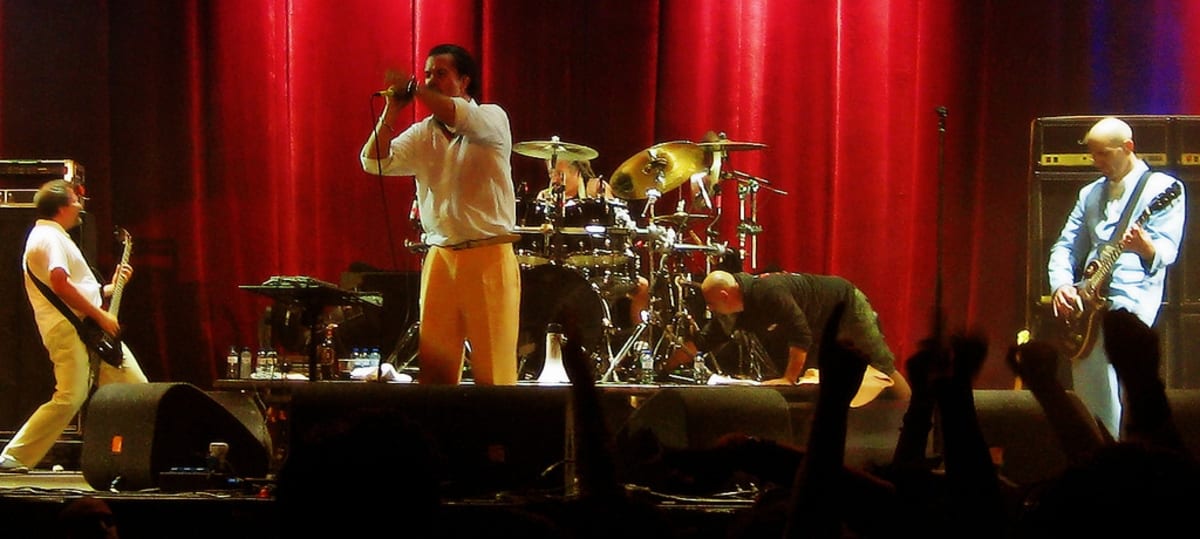
Mike Patton is talking about Faith No More again, and the way he’s talking about it matters. In a recent interview, he described the band’s final run as carrying a sense of “closure” — not a headline‑grabbing breakup, but the kind of quiet understanding that sometimes settles in during the last shows of a long story. That framing doesn’t slam the door. It lets it stay cracked, which is exactly why this moment feels important.
For a band with a legacy this deep — and for a city like San Francisco that still feels their fingerprints on everything heavy and weird — even a soft hint of finality hits hard. But Faith No More have never been a neat, linear narrative. They’ve been a constellation: the record‑breaking highs, the long gaps, the reunion era, the one‑foot‑in‑the‑future restlessness. If this is the end, it deserves the full context. And if it isn’t, that context is exactly why the story still has fuel.
Faith No More didn’t just influence a scene — they rewired it
Faith No More’s impact isn’t a footnote in alternative metal; it’s the foundation. Their 1989 breakthrough The Real Thing didn’t just put them on the map — it cracked the idea of what heavy music could be. It wasn’t purely thrash. It wasn’t purely rock. It was a collision: groove, funk, art‑school oddness, aggression, and the kind of theatrical tension that made everything feel dangerous.
Then came Angel Dust in 1992 — a record that still confounds categories and is stronger now than it was when it first landed. That album is the DNA line for countless bands that followed. Nu‑metal, alternative metal, post‑hardcore, even modern metalcore and progressive scenes borrowed its blueprint: dynamic shifts, a fearless sense of arrangement, a refusal to be boxed in. When you hear bands that sound like they’re dragging multiple genres into one room and locking the door behind them, you’re hearing echoes of Faith No More.
And it wasn’t just the genre blend. It was the attitude: no apologies, no script, no reason to conform. The band’s legacy is full of acts who became themselves because Faith No More already proved that “yourself” could be loud, surreal, and uncompromising. There are decades of bands who probably wouldn’t exist in their current form without Faith No More showing the pathway.
Bay Area roots, global impact
San Francisco isn’t just a backdrop in the Faith No More story — it’s the engine. This is a Bay Area band through and through, born out of a city that has always been willing to let the weird rise to the surface. The band’s early history lives in that regional mix of punk, metal, art, and experimental chaos that made Northern California a different kind of breeding ground. If you grew up around the scene, Faith No More weren’t “just a band.” They were proof that the local sound could go global without being diluted.
That Bay Area identity matters now more than ever because it anchors the legacy in place, not just in time. As the city continues to evolve, Faith No More remains one of the clearest cultural markers of what the area has contributed to heavy music: intelligence, risk, and a sense of individuality that still feels rare.
The Patton era and the long shadow of the catalogue
Mike Patton’s arrival didn’t just change the band’s sound — it expanded their vocabulary. His voice became an instrument of extremes: melodic and deranged, tender and violent, controlled and feral. That versatility didn’t just define the band’s peak; it set a bar for frontmen across the next three decades. If you’ve ever heard a vocalist snap from clean hooks to animalistic chaos in a single breath, you’ve heard a lineage that traces back to Patton.
Albums like King for a Day… Fool for a Lifetime and Album of the Year kept moving the target even as the industry around them kept trying to standardize what “alternative metal” meant. Faith No More never let that label stick. They kept mutating, even when it made them harder to market. And that stubborn refusal to simplify is why the catalogue still feels alive instead of dated.
The reunion era: not nostalgia, a second life
When Faith No More reunited in 2009, it didn’t feel like a nostalgia lap. It felt like a second life. The band was vital on stage, and the return gave a newer generation the chance to see a blueprint band in real time. That era also led to Sol Invictus in 2015 — a record that proved they still had something to say beyond the shadow of their past.
That’s what makes the present so complicated. The reunion era wasn’t a simple reunion. It was its own chapter. It carried forward long enough to feel permanent, then paused in a way that felt unresolved. And now, with Patton describing a quiet sense of closure, the story sits in this tension between “finished” and “unfinished.”
Why the “closure” comment matters
Patton’s recent comment about an “unspoken” sense of closure lands because it’s not dramatic — it’s honest. The last stretch of Faith No More shows felt significant even when they weren’t framed as a farewell. That’s a deeply human thing: you often realize a chapter is ending only after it’s already over.
“I didn’t really think so at the time, but, yeah, maybe,”
“And I think that we all kind of felt it, but it was unspoken.”
“And it’s funny: when you’ve been in a band or a musical situation for a period of time, you always, in the back of your head, you’re kind of thinking, ‘Well, maybe this is it.’ And I don’t mind that feeling. I don’t see it as a sad thing. I see it as being present and being able to really appreciate it while it’s happening.”
He also reiterated something fans often forget: Faith No More was never a “main project” to him. It was one of many lanes he ran at full speed. That doesn’t diminish the band; it explains the operating system. If everything he does is equal, then nothing gets forced. And that means any return — if it happens — will be because it feels right, not because it’s expected.
The broader band context: friction, distance, and respect
The public record over the past few years has been clear enough: the 2021 tour was scrapped due to Patton’s mental health struggles, and the reunion momentum never fully recovered. Other members have acknowledged the strain and the uncertainty. None of that is shocking. It’s the reality of a band with decades of history, strong personalities, and the weight of expectation.
But there’s also something else in those interviews: a consistent respect for what the band already achieved. Even when the future sounds murky, there’s no sense of regret in the way they talk about what they built. That matters, because it keeps the story from feeling bitter. It keeps the legacy intact.
Why this story deserves a full feature now
If Faith No More are truly done, the importance isn’t just that a legendary band ends — it’s that a specific type of band ends. They’re one of the few acts that truly cut a new shape into heavy music, and their influence is so widespread that we often forget where it came from. From alternative metal to modern metalcore to genre‑agnostic heavy artists, their fingerprints are everywhere: dynamic song structures, left‑turn arrangements, and the confidence to be strange without apologizing for it.
And for Metal Mantra, this is personal. Faith No More are a Bay Area institution. Their story is tied to the geography, the scene, the culture. Covering them isn’t just about documenting a band — it’s about documenting a piece of the city’s identity in heavy music.
The glimmer of hope
Still, this doesn’t read like a final goodbye. Faith No More have always operated in cycles, not straight lines. They’ve gone silent and returned before. They’ve ended chapters and started new ones when no one expected it. Patton’s words sound like a man at peace with what was — not a man slamming the gate on what could be.
So this feature isn’t a eulogy. It’s a marker in the story. It’s a moment to acknowledge the weight of the legacy and the possibility that, one day, the band could decide to step back into the light for one more run — or even one more song.
Because with Faith No More, the end is never fully written until they write it themselves.
To be continued.